
Most of us assume time moves like a river, the past flowing behind us and the future approaching. But if we examine our own experience carefully, we see something different.
When you regret the past, you are not entering the past. You are activating memory. When you worry about the future, you are not entering the future. You are rehearsing projection. Both occur now. The only place experience actually unfolds is in this present moment.
Classical Buddhist thought described this as momentariness: existence arising and ceasing in brief intervals. What appears continuous is, in fact, a succession of moments. The river looks stable, but the water is never the same. Your identity feels continuous, yet your reactions arise and pass. The anger you have “carried for years” is reconstructed again and again. The anxiety about tomorrow is rehearsed again and again. Suffering deepens when we treat these recurring mental events as permanent structures of self.
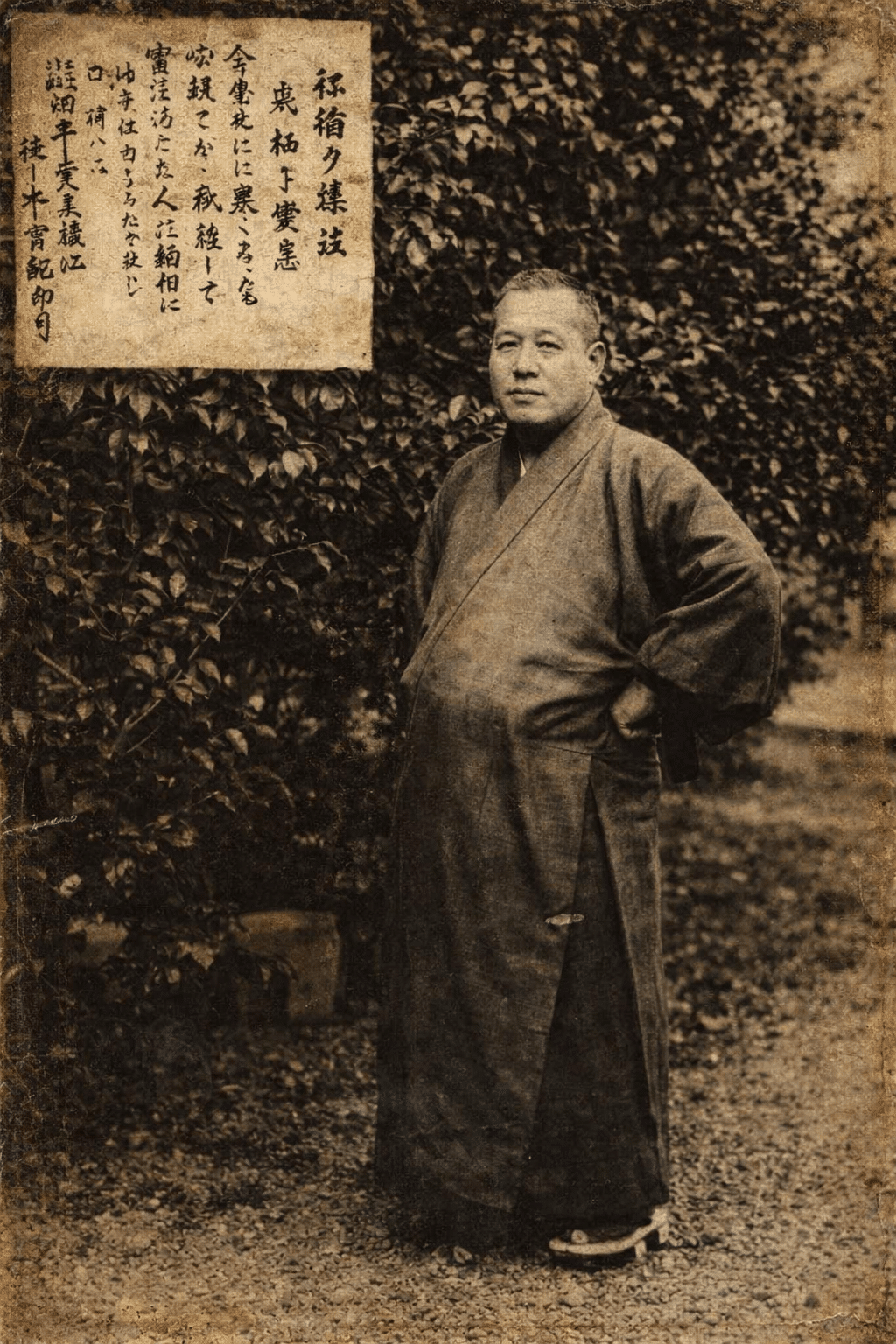
It is in this context that Mikao Usui placed the phrase “Just for today” at the beginning of the Five Precepts. He did not place it casually. He placed it first.
Historically, the phrase emerged within affirmation-based health teachings circulating in Taisho-era Japan, particularly those of Suzuki Bizan. In Usui’s system, however, it became something more than encouragement. It became discipline.
“Just for today” does not mean twenty-four hours. It means: restrict attention to this moment of conduct.
Just for today, do not anger.
Don’t worry.
Be grateful.
Work diligently.
Be kind to people.
Each line narrows responsibility to what is immediately before you. You are not asked to eliminate anger forever. You are asked not to feed it now. You are not asked to solve your life. You are asked to act correctly in this moment.
This is not comfort. It is correction.
And this is where Reiki becomes practical rather than philosophical. Usui did not pair the Precepts only with meditation. He paired them with hands-on practice.
When you place your hands on your body in self-treatment, you cannot be in yesterday or tomorrow. Sensation occurs now. Warmth in the palms is not mystical proof. It is immediacy. Hands resting without commentary interrupt mental rehearsal.
Each time the mind drifts toward regret or anticipation, you return physically. Place the hands. Sit in gassho. Recite: Just for today.
Over time, reaction shortens. Worry weakens. Conduct steadies. Kokoro clarifies.
In Japanese understanding, kokoro is the integrated center of the person. Thought, feeling, will, and responsiveness are not divided. When kokoro is unsettled, perception distorts. When kokoro steadies, conduct steadies.
The Precepts are not inspirational slogans. They are conditioning tools. “Just for today” prevents practice from becoming abstract. It returns everything to this breath, this action, this response.
That is why the phrase carries weight. Not because it comforts. Because it disciplines.
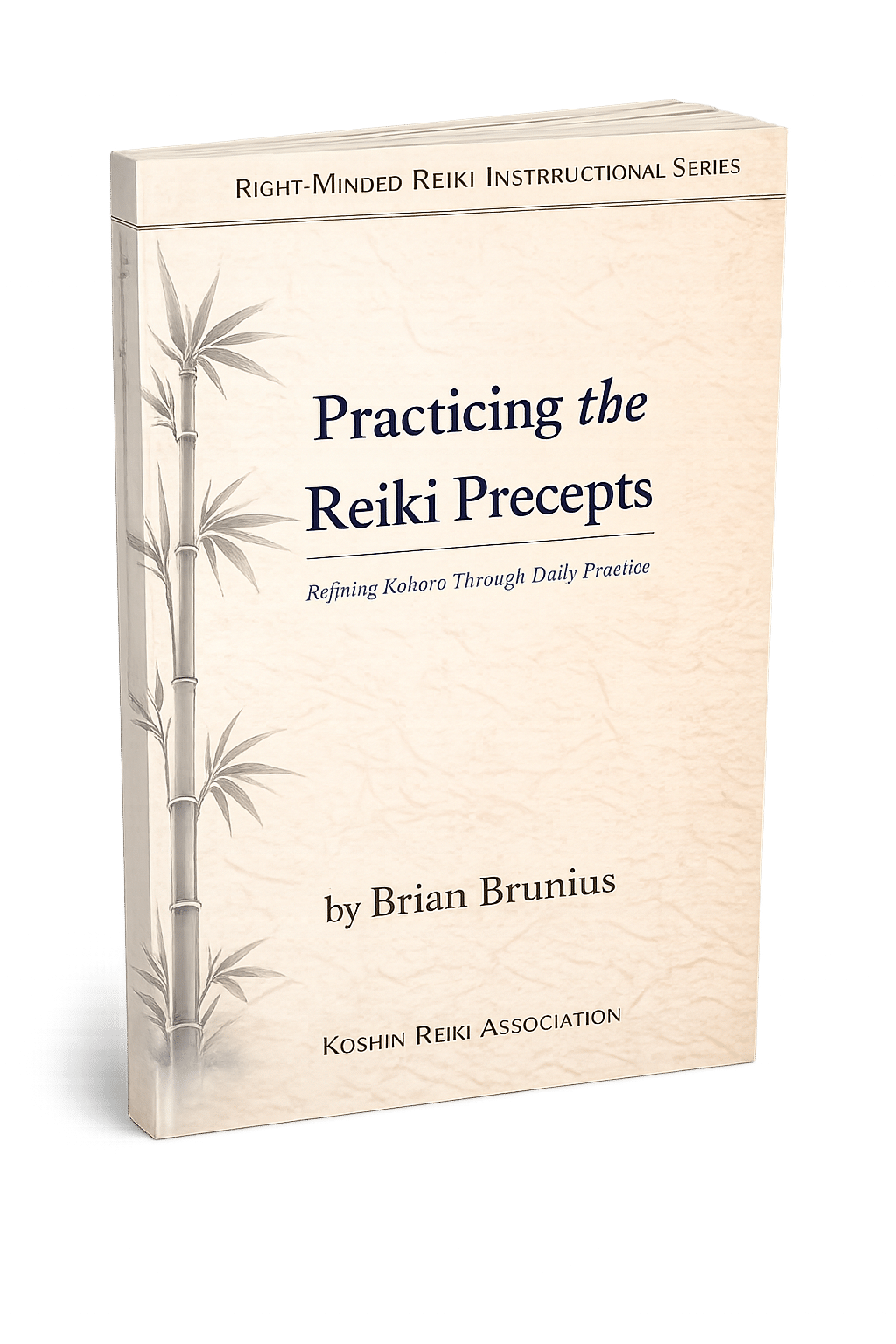
If you would like to explore the Precepts in their full historical and practical context, including Mikao Usui’s signed and sealed teaching document and the method of daily recitation and cultivation, you can find that work in Practicing the Reiki Precepts: Refining Kokoro Through Daily Practice.
The book restores the complete text and places it within the structure of early Reiki training: repetition, self-treatment, meditation, and ethical refinement.
It is not inspiration. It is a manual for practice.
You can view the book here:
Want more like this?
We share deeper thoughts, behind-the-scenes insights, and things we don’t always publish on the blog over on our Substack. If this post was useful, you’ll probably enjoy what we send there too.
👉 Subscribe on Substack to keep reading.