
Experiencing the Heart-Mind in Usui’s Reiki Practice

When most people first learn Reiki, they focus on technique. They learn hand positions, practice treatments, and discover that something real happens when their hands rest on the body.

But Mikao Usui did not teach Reiki only as a healing technique. He taught it as a path of self-cultivation.

At the center of that training was the cultivation of kokoro.

Kokoro is often translated as “heart” or “mind,” but in practice it refers to the condition of the whole person. It includes our thoughts, emotions, intentions, and the condition of the body as one integrated field of experience.

If this inner condition is disturbed, Reiki practice becomes disturbed. When it becomes steady, Reiki begins to function naturally.

For Usui, cultivating kokoro was not philosophy. It was the work itself.
Feeling Kokoro in Your Own Experience

In Western thinking we often divide experience into separate parts. We speak of thoughts, emotions, and physical sensations as if they function independently.

In practice they rarely do.

A memory produces an emotion. The emotion changes the body. The condition of the body influences attention. Together these movements form a single field of experience.

In Japanese traditions this unified inner condition is called kokoro.

The practices Usui taught were designed to gradually stabilize this condition.

A Simple Exercise

Sit quietly for a moment and allow your attention to settle.

Now recall a recent situation that made you irritated or upset. Observe carefully what happens inside you.

Notice the thoughts that appear. Notice the emotion that arises. Notice any change in the body, perhaps tension in the shoulders or a tightening in the breath.

After a moment, let that memory go.

Now bring to mind something that makes you feel grateful. Again observe carefully. Notice how the body feels. Notice the quality of the breath and the tone of your thoughts.

Most people observe that the entire inner condition shifts together. Thoughts, emotions, and physical sensations move as one integrated field.

That field is what we call kokoro.

A Teaching Story

A student once asked a Reiki teacher why Reiki sometimes felt strong and other times weak.

The teacher replied, “Reiki does not change. The condition of the practitioner changes.”

The student began paying attention to this. On days when he was rushing, worried, or irritated, his practice felt scattered. On days when he had spent time quietly with meditation and the Precepts, his hands seemed to settle naturally and treatment flowed easily.

Nothing external had changed. Only the condition of his kokoro had changed.

Another Observation

A practitioner who had been practicing Reiki for many years once described a similar realization.

“When my mind is busy,” she said, “I feel like I have to try to make Reiki work. When my mind becomes quiet, Reiki seems to move by itself.”

This observation reflects an important principle in Usui’s teaching. Reiki does not need to be forced or directed. Cultivation gradually removes the disturbances that interfere with its natural functioning.

How Kokoro Is Cultivated in Reiki Practice

Usui did not ask his students to analyze their psychology. Instead he gave them daily practices that gradually refined the condition of kokoro through repetition.

These included the Reiki Precepts, meditation practice, daily self-treatment, and contemplation of poetry. Through steady practice the practitioner gradually became more stable internally. From that cultivated condition, the ability to help others developed naturally.

Together these practices formed the training system Usui taught his students.

Observing Kokoro During Reiki

The next time you give Reiki, pause for a moment before beginning the treatment.

Observe the condition of your attention. Notice whether the mind feels calm or distracted. Notice whether you are thinking about past events or future concerns. Notice the quality of your breathing.

Then begin the treatment and simply observe.

Rather than trying to make something happen, allow your attention to remain steady. Many practitioners discover that when the inner condition becomes quiet and stable, Reiki begins to function more naturally.

Kokoro and the Reiki Precepts

The Reiki Precepts begin with a simple phrase: “Just for today.”

This phrase stabilizes attention in the present moment.

Anger tends to pull attention toward the past. Worry tends to pull attention toward the future. The Precepts gently return attention to the present condition of kokoro.

Through daily practice they gradually reshape how we meet experience.

The Long Path of Practice

Cultivating kokoro is not something that happens in a single moment. It develops gradually through daily practice.

Meditation steadies the body. The Precepts clarify conduct. Self-treatment allows Reiki to work through our own condition.

Over time the practitioner becomes less reactive, more attentive, and more available. Helping others through Reiki begins to arise naturally from that cultivated condition.

This was the heart of Mikao Usui’s training system.

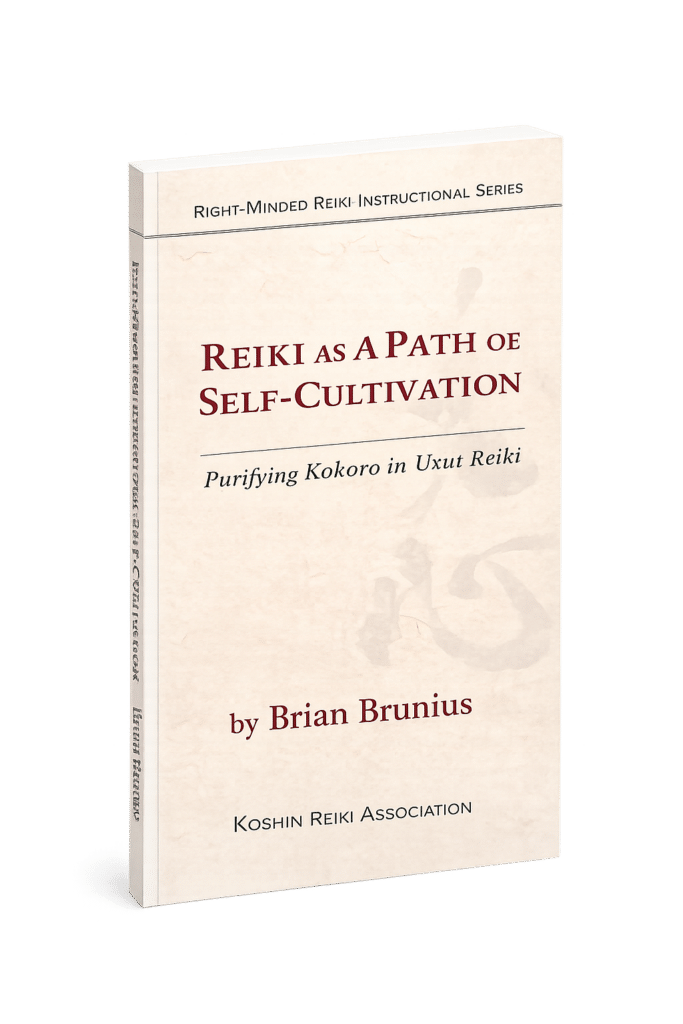
Book cover: Reiki as a Path of Self-Cultivation by Brian Brunius and the Koshin Reiki Association

Deepening Your Practice

If you would like to explore this dimension of Reiki more deeply, the book Reiki as a Path of Self-Cultivation: Purifying Kokoro in Usui’s Reiki examines how Usui structured training and why cultivation of kokoro stands at the center of the system.

Rather than presenting Reiki as a technique alone, the book explores the practices that gradually refine the practitioner and support the long path of Reiki training.

Learn More